Ad

This is default featured slide 1 title

Go to Blogger edit html and find these sentences.Now replace these sentences with your own descriptions.

This is default featured slide 2 title

Go to Blogger edit html and find these sentences.Now replace these sentences with your own descriptions.

This is default featured slide 3 title

Go to Blogger edit html and find these sentences.Now replace these sentences with your own descriptions.

This is default featured slide 4 title

Go to Blogger edit html and find these sentences.Now replace these sentences with your own descriptions.

This is default featured slide 5 title

Go to Blogger edit html and find these sentences.Now replace these sentences with your own descriptions.

Sunday, April 26, 2020

Heredity and Evolution class 10 WBBSE and CBSE Notes By Hasan sir

Heredity and Evolution class 10 WBBSE and CBSE Notes By Hasan sir
1. The transmission of characters from parent to their offsprings is known as heredity.
  • The study of heredity and variations is known as genetics.
  • Clones are those organisms which are the carbon copies of one another.
  • Variation in sexually reproducing organisms are caused due to the following factors like environment, crossing over and recombination of genes and mutation.
  • The first study of inheritance was done by Gregor Mendel on garden pea.
  • Paired condition of chromosomes is known as diploid.
  • Unpaired condition of chromosomes is known as haploid.
  • DNA (Deoxyribo Nucleic Acid), RNA (Ribo Nucleic Acid) is the genetic material in all organisms.
2. Mendel’s laws of inheritance are
(i) Law of Dominance
(ii) Law of Segregation (Law of purjty of gametes)
(iii) Law of Independent Assortment
3. Genotype is the composition of genes present in an organism and the characteristic which is visible in an organism is called its phenotype.
4. When two parents cross (or breed) to produce progeny (or offsprings), then their progeny is called F1-generation (First Filial Generation) and when the first generation progeny cross among themselves to produce second progeny, then this progeny is called F2-generation or second Filial Generation.
  • Mendel conducted his famous experiments on garden pea (Pisum sativum).
  • He used a number of contrasting characters like round / wrinkled seeds, tall/ short plants, white/ violet flowers and so on.
5. During Monohybrid Cross
  • When tall pea plants are crossed with short pea plants then in Fi generation only tall plants were obtained.
  • F2 progeny ofFi tall plants are not all tall but one quarter of them are short indicating that both tallness and shortness traits were inherited in F1 but only tallness trait was expressed due to dominance.
  • In dihybrid cross two pairs of contrasting characters were considered. Tall plant with round seeds were crossed with short plant with wrinkled seeds. In Fi tall plants with round seeds were obtained. On selfing these F, plants with F2 produced tall plants with round seeds, short plant with wrinkled seeds and some new combinations (tall plant with wrinkled seeds and short plant with rounds seeds) were also obtained. The tall/short trait and round wrinkled traits are independently inherited.
  • The expression of a particular trait is controlled by gene.
6. DNA is the source of making protein in a cell.
The section of DNA that provides information for one protein is called gene.
7. Physical and Chemical Basis of Heredity
Mendel (1866) said that heredity was controlled by particles, called germinal units, or factors.
8 Sex determination is the process by which the sex of a person is determined.
All human chromosomes are not paired. 22 pairs are called autosomes. Women have a perfect pair of sex chromosomes XX. But men have a mismatched pair XY.
9. Evolution
It is the sequence of gradual changes which take place in the primitive organisms over millions of years in which new species are produced.
A. The evidences of evolution are :
i. Homologous organs,
ii. Analogous organs, and
Fossils
B. Theories of Evolution
Jean Baptiste Lamarck gave the first theory of evolution.
Darwin’s Theory of Evolution
Charles Robert Darwin (1809-1882) explained the evolutionary principle in his famous book “The origin of species”. The theory proposed by him is popularly known as theory of natural selection or Darwinsim.
The main features of the theory of natural selection are as follows:
(i) Over production
(ii) Limited food and space
(iii) Struggle for Existence
(iv) Variations
(v) Natural Selection or Survival of the Fittest
10. Speciation : The process by which new species develop from the existing species is known as speciation.
The factors which leads to speciation are :
  • Geographical isolation
  • Genetic drift and
  • Variations
11. Classification
Evolutions are of three types :-
(i) Convergent Evolution
(ii) Divergent Evolution, and
(iii) Parallel Evolution.
12. Fossils : The remains of dead plants or animals that lived in the remote past are known as fossils.
Various kinds of fossils are : Ammonite, Trilobite and Dinosaur.
13. Evolution by Stages : Evolution of complex organs have taken place bit-by-bit over generations.
For example eye, feathers of birds have evolved because of survival advantage of intermediate stages.
Thus changes in DNA during reproduction are the main cause of evolution.
14. Human Evolution : All have beings belong to single speceis Homo sapiens, although there were many races of humans.
They have originated in Africa, some ancestors left Africa and migrated to West Asia, Central Asia, Eurasia South Asia, East Asia, Indonesia, Australia, America, while others stayed there.
Excavating, time-dating, studying fossils, determining DNA Sequences have been used for studying human evolution.

LIGHT (REFLECTION AND REFRACTION) BY HASAN SIR WBBSE AND CBSE ALL BOARD


LIGHT (REFLECTION AND REFRACTION)
BY HASAN JAWED Class 10 WBBSE and CBSE
1. Ray of Light : A line drawn in the direction of propagation of light is called a ray of light.
2. Beam of Light : A group of rays of light emitted by a source of light is called a beam of light. A light beam is of three types.
(i) Parallel beam : A group of light rays parallel to each other is known as parallel beam of light. 7.
(ii) Divergent beam : A group of light rays spreading out from a source of light is called divergent beam of light.
(iii) Convergent beam : A group of light rays meeting at a point is called convergent beam 8. of light.
3. Reflection of Light : There are some surfaces which have ability to send the light back in the same medium when light strikes it. This 9. phenomena of sending the light back in the same medium by a surface is called reflection of light.
(i) The incident ray, the reflected ray and the normal at the point of incidence, all lie in a same plane.
(ii) The angle of incidence is always equal to the angle of reflection, ∠i = ∠r.
4. Image : When light rays meet or appear to meet after reflection from a mirror,then it is called an image.
1. Real Image : It is a kind of image which is formed by actual intersection of light rays after reflection.
2. Virtual Image : It is a kind of image which is formed by producing the reflected rays backward after reflection.
5. Plane Mirror : Plane mirror is a piece of glass whose one side is polished by using silver paint, which is covered by a coating of red paint to protect the silver layer.
6. Spherical Mirrors : It is part of hollow glass sphere whose one surface is polished.
There are two types of spherical mirror.
(i) Concave Mirror : It is a spherical mirror whose outer surface is polished and inner or concave side is reflecting surface.
(ii) Convex Mirror : It is a spherical mirror whose inner is polished and outer side or convex side is the reflecting surface.
Principal Focus :
A point on the principal axis of a spherical mirror where the rays of light parallel to the principal axis meet or appear to meet after reflection from the mirror.
Focal Length :
The distance between the pole (P) and principal focus(F) of a spherical mirror is called the focal length of the mirror. It is denoted by f.
Uses of Concave Mirror :
(i) It is used as a shaving mirror because when it is placed close to the face, it forms a large image.
(ii) It is used in solar heating devices like solar cooker, because it converges Sun’s rays over a small area to produce high temperature.
(iii) It is used for security checking purposes.
10. Uses of Convex Mirror :
(i) It is used as rear view mirror in automobiles because it gives erect image as well as diminished due to which Pt has wider field of view.
(ii) It is also used in street lights.
11. Mirror Formula :
It is a relation between distance of object, distance ofimage from the pole ofthe mirror and it’s focal length, i.e., relation between ‘u’, ‘v and It is given by

Science Class 10 Notes - Light (Reflection and Refraction)

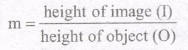
12. Magnification : It is defined as the ratio of height of image to the height of the object. It is denoted by letter m.

Science Class 10 Notes - Light (Reflection and Refraction)

13. Refraction of Light : The bending of ray of light when it passes from one medium to another is called refraction of light.
Laws of Refraction :
(i) The incident ray, the refracted ray and the normal at the point of incidence all lie in the same plane.
(ii) When a ray of light undergoes refraction then the ratio of sine of angle of incidence to the sine of angle of refraction is constant.
14. The Refractive Index : The refractive index of medium 2 with respect to medium is given by the ratio of the speed of light in medium 1 and the speed of light in medium 2. This is usually represented by the symbol n21. This can be expressed in an equation form as

Science Class 10 Notes - Light (Reflection and Refraction)

15. Refraction by spherical lenses : Lens is a transparent medium which is formed by joining two pieces of spherical glass. There are two types of lenses.
(i) Convex Lens : It is a lens which is thicker at the centre and thinner at the edges.
(ii) Concave Lens : It is a lens which is thinner at the centre and thicker at the edges.
16. Terms related to a lens
Optical Centre of Lens : It is the centre of the lens through which light can pass without any deviation.
Principal Axis : It is the line passing through optical centre and is perpendicular to the line joining its edges.
Principal Focus : It is a point on the principal axis where all light rays which are parallel to principal axis either converge or appear to diverge from, after refraction.
17. Lens formula :

Science Class 10 Notes - Light (Reflection and Refraction)

18. Magnification : Magnification, m = h2/h1
Ratio of height of image to the height of object.
It is also given by v/u i.e., Ratio of distance of image to the distance of object.

Science Class 10 Notes - Light (Reflection and Refraction)

19. Power of a lens : A beam of light parallel to principal axis either gets converged or diverged after refraction by a lens. Some lenses converge the beam of light to a small extent and some lenses converge it to a large extent. This ability of lens to converge or diverge a beam of light is known as the power of lens.
Si unit of power of lens is dioptre : One dioptre is the power of a lens whose focal length is 1 m.
Power of a combination of two or more lenses :
If two or more lenses are placed together to form a combined lens then the power of this combined lens is equal to the sum of the powers of individual lenses.
P = P1 + P2 + P3 + …

Life process class 10 By Hasan Jawed (hj study)


Hasan Jawed STUDY NOTES

Control and coordination class 10 Notes by Hasan


Very important knowledge

 Hasan Jawed